
UK dental practice VAT guide · Updated 9 November 2026
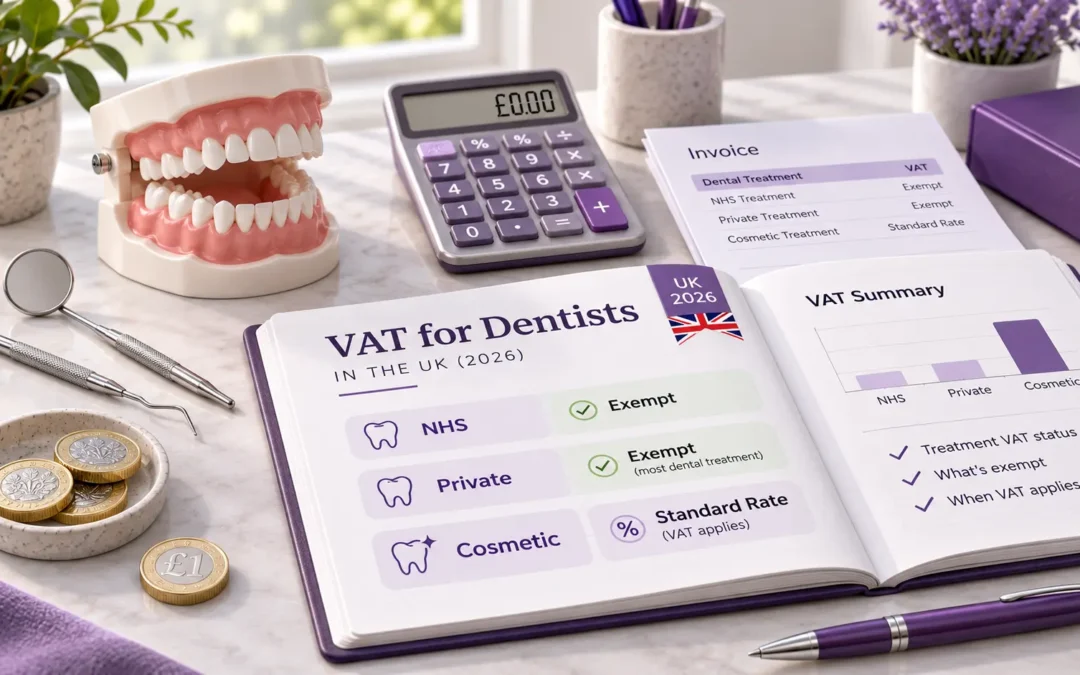
Is dental treatment VAT-exempt in the UK? Usually, yes—when an appropriately registered dental professional provides care whose main purpose is to protect, maintain or restore oral health. The exemption applies to qualifying NHS and private treatment. Purely cosmetic procedures and separately sold retail products may be taxable instead. The treatment’s purpose—not simply whether a patient pays privately—is what matters.
That distinction can become expensive for an otherwise well-run dental practice. A principal may receive NHS contract payments, private clinical fees, whitening fees, product sales and income from associates, yet those receipts do not necessarily belong in the same VAT category. If taxable income increases, registration and input VAT recovery need another look.
This guide explains the UK VAT rules for dentists using HMRC guidance current to November 2026. It is designed for associate dentists and practice owners—including those working with a dental accountant in Stanmore or London—who want to understand the figures before speaking to their accountant.
1. Which dental treatments are exempt from VAT?
HMRC’s VAT Notice 701/57 explains that dental care and treatment can be VAT-exempt when supplied by an eligible registered dental professional. The key test is the principal purpose of the service: protecting, maintaining or restoring the patient’s health.
Clinical services such as examinations, treating tooth decay, extractions, treatment of gum disease, medically appropriate restorative work and qualifying dental prostheses will commonly meet that test. The circumstances still matter: registration, who supplies the service and whether the supply is genuinely part of care are relevant.
Private does not mean taxable. A privately funded filling can be exempt for the same reason as an NHS filling. Likewise, an NHS label does not automatically settle the VAT liability of a separate retail product or other non-clinical supply.
| Income or supply | Usual VAT position | What to check |
|---|---|---|
| NHS clinical dental treatment | Generally exempt | Qualifying healthcare supplied by eligible professionals |
| Private fillings, oral-health examinations and restorative treatment | Generally exempt | Clinical purpose and treatment records |
| Teeth whitening or cosmetic dentistry | Case by case | Part of oral healthcare, or purely aesthetic? |
| Separately sold toothbrushes, toothpaste and floss | Usually standard-rated | Distinct retail sale rather than inseparable healthcare |
| Separate advisory or consultancy work | Often taxable | Nature of the advice and whether any other exemption applies |
| Facilities supplied to a practising associate | May be exempt | HMRC’s specific conditions for inter-dentist services |
This is a practical overview, not a classification of every possible treatment. Do not treat the examples as a substitute for reviewing the treatment and contractual facts. HMRC’s cosmetic dentistry guidance specifically says each case must be considered on its own merits.
2. Is private cosmetic dentistry subject to 20% VAT?
Purely cosmetic dentistry outside healthcare is generally standard-rated. However, the word “cosmetic” is not decisive by itself. For example, improving appearance may be one outcome of a course of restorative treatment undertaken to protect oral health. HMRC accepts that cosmetic services delivered as part of a qualifying dental treatment programme can form a single exempt healthcare supply.
For borderline work, ask three questions before coding the invoice:
- What is the documented clinical need and principal purpose of the treatment?
- Is the treatment provided by an appropriately registered professional as part of oral healthcare?
- Are any non-clinical or retail supplies separate, rather than part of one exempt treatment?
Keep the clinician’s description, treatment plan and billing category aligned. A practice should not rely only on the software’s appointment label—“whitening”, “aesthetics” or “private”—to decide VAT.
Facial aesthetic treatments, non-clinical beauty services and other work outside dental healthcare need their own analysis. Do not assume that the professional status of the provider makes every service exempt. HMRC’s purpose test is central.
3. Do dentists need to register for VAT once turnover reaches £90,000?
Not necessarily. The compulsory VAT-registration test is based on taxable turnover, not all practice income. Exempt clinical dental income is normally excluded. The VAT-registration threshold is currently more than £90,000 of taxable turnover in a rolling 12-month period. Registration can also be required when taxable turnover is expected to exceed £90,000 in the next 30 days alone. See HMRC’s VAT registration rules.
Consider a practice with £550,000 of qualifying exempt dental care and £58,000 from separately taxable retail and purely cosmetic supplies. On those facts alone, the total income is over £600,000, but taxable turnover remains below £90,000. The practice does not cross the compulsory registration threshold just because its overall income is large. Other taxable transactions, related activities, supplies or forward-looking tests could change the outcome.
Now suppose the taxable income increases to £92,000 in the relevant rolling 12 months. That changes the VAT-registration position even if the vast majority of the practice’s clinical income remains exempt. You should then review the registration deadline and effective date rather than wait for the accounting year-end.
For further help with VAT records, see Samsaad’s VAT returns and compliance services.
4. Can a dental practice reclaim VAT on equipment and expenses?
Here is a distinction many practice owners miss: VAT-exempt is not the same as zero-rated. VAT paid on purchases used solely to make exempt supplies is normally not recoverable, even when the practice earns substantial clinical fees. That can make VAT on surgery equipment, refurbishments, professional fees and overheads a significant business cost.
Where a VAT-registered practice makes both exempt and taxable supplies, the partial-exemption rules may apply. HMRC’s VAT Notice 706 requires businesses to consider three broad categories:
- Purchases used only for taxable supplies: VAT is generally recoverable, subject to normal input-tax rules.
- Purchases used only for exempt supplies: VAT is generally not recoverable, subject to applicable exceptions.
- Shared costs: VAT must be apportioned using an appropriate partial-exemption method, with annual adjustment as required.
For example, an accountancy bill, software subscription or utility cost supporting both taxable and exempt activities may require an allocation. It is not correct to assume the practice can reclaim 100% of VAT on every purchase merely because it is VAT registered, or to use the percentage of private appointments as the recovery percentage.
What is the partial-exemption de minimis rule?
There is a limited rule allowing recovery of otherwise exempt input VAT where the total exempt input tax is no more than £625 per month on average and no more than 50% of total input tax over the relevant period. Both tests matter, and the full rules and annual adjustment must be applied. This is not a general £625 VAT refund for every dentist.
Complex expenditure—particularly major equipment, leases, property projects or shared premises—deserves a separate review. For financial record preparation beyond VAT, read Samsaad’s dental practice accounts year-end checklist.
5. Worked example: how to split a mixed dental practice’s income
Imagine a dental practice that records the following annual supplies. These are illustrative numbers, not the accounts of a real Samsaad client.
| Revenue category | Annual value | VAT treatment assumed |
|---|---|---|
| Qualifying NHS care | £300,000 | Exempt |
| Qualifying private clinical care | £240,000 | Exempt |
| Purely cosmetic, non-therapeutic services | £52,000 | Standard-rated |
| Separate retail product sales | £20,000 | Standard-rated (assumed) |
| Total | £612,000 | Taxable element: £72,000 |
The taxable element is £72,000 in this simplified example, not £612,000. Assuming no other taxable supplies, registration triggers or complications, £72,000 would be below the current compulsory VAT-registration threshold. These figures must not be used to assume that a registered practice can ignore VAT or that any particular procedure is automatically exempt.
For real accounting records, the income headings in your practice-management system should support the treatment—not just show a combined “private patients” total. Our existing guide on separating NHS and private dental income explains the bookkeeping side in more detail.
6. What about fees between a practice and its associate dentists?
The VAT treatment of facility charges and associate arrangements is fact-specific. Section 10.2 of HMRC’s VAT Notice 701/57 explains that charges between practising dentists at the same practice can be exempt when the services or facilities are predominantly medical in nature and necessary to enable the recipient to practise dentistry. That treatment does not automatically cover a non-dentist landlord, sales of dental equipment or retail stock.
Review who supplies the facilities, what the associate agreement actually covers and how any laboratory or other costs are billed. A generic “chair rental” label is not enough to decide VAT. If you are working as a self-employed associate rather than running the practice, see what an accountant for dental associates should cover.
7. How should a practice keep evidence for a VAT review?
Good records make a VAT decision easier to explain to HMRC and easier to maintain when the treatment mix changes. A workable monthly process is:
- Separate exempt clinical income from potentially taxable cosmetic, retail and other income in the practice-management software.
- Document the clinical purpose and relevant treatment-plan evidence for borderline services; avoid unnecessary personal patient data in accounting exports.
- Reconcile payment processor, patient finance and bank receipts with the actual supply categories.
- Track taxable turnover on a rolling 12-month basis, including all taxable activities of the relevant business.
- Where registered, allocate purchase VAT to taxable, exempt or shared categories and retain supporting invoices.
- Check the partial-exemption method, annual adjustment and any unusual one-off equipment or property purchase.
- Review changes in services, associate contracts and practice structure before relying on previous treatment decisions.
For a mixed NHS/private practice, the same accounting system should let you explain both the commercial performance of treatment categories and the VAT classification of those supplies. The two questions are related but are not identical.
8. When should a dentist speak to a specialist accountant?
A VAT review is particularly useful when you are launching cosmetic services, starting retail sales, opening another surgery, changing associate arrangements, planning a major equipment purchase or approaching £90,000 of taxable income. It is also important if the VAT codes in your accounting software have been set up by treatment name alone.
Practice owners comparing their future options can also read Samsaad’s guide to buying a dental practice, which covers wider financial due diligence and practice structure.
Dental accountant in Stanmore? Talk to Samsaad
Samsaad Accounting Limited supports dentists, dental associates and practice owners in Stanmore, London and beyond. If you need to review how your dental income is recorded, whether VAT registration is required, or which purchase VAT may be recoverable, bring your figures and questions to an accounting discussion.
Practice owners needing help with wider accounts and reporting can also explore our dental practice accounting services.
Frequently asked questions: VAT for dentists
Is private dental treatment VAT exempt?
Yes, qualifying private dental care provided by an eligible registered professional is generally exempt when its main purpose is to protect, maintain or restore health. Whether the patient is privately funded does not by itself make treatment taxable.
Do dentists charge VAT on teeth whitening?
It depends on the treatment’s principal purpose and circumstances. Work supplied purely for cosmetic reasons outside healthcare is generally standard-rated. Qualifying whitening that forms part of an oral-health treatment programme may be exempt. Keep clinical evidence supporting the decision.
Does exempt NHS income count towards the £90,000 VAT threshold?
No. Exempt NHS clinical income is normally excluded from taxable turnover for registration purposes. Taxable retail, non-therapeutic cosmetic and other taxable supplies count, subject to the full rules.
Can dentists reclaim VAT on a new dental chair?
It depends on how the chair is used and the practice’s VAT position. Input VAT relating solely to exempt healthcare is normally not recoverable. A VAT-registered mixed practice may be able to recover a proportion, subject to partial-exemption and other applicable rules.
What is partial exemption for a dental practice?
It is the method a VAT-registered practice uses to determine how much purchase VAT can be recovered when it makes both taxable and exempt supplies. Costs are directly attributed or apportioned, with annual adjustments where required.
Are dental prostheses subject to VAT?
Qualifying dental prostheses supplied under the relevant statutory conditions may be exempt. VAT treatment depends on who supplies them and the precise supply; do not assume all laboratory work or commercial equipment sales are exempt.
Do associate dentists need to register for VAT?
An associate whose supplies are entirely exempt dental healthcare may not need to register solely because their exempt fees are high. Taxable supplies, other business activities and unusual arrangements require separate consideration.
Can a Stanmore dental accountant help with VAT registration?
Yes. A dental accountant can help review income categories, assess taxable turnover, consider registration and input VAT recovery, and organise VAT records. Samsaad offers dental accounting and VAT-related support to practices in Stanmore and London.
Sources and further reading
- HMRC VAT Notice 701/57: Health professionals, section 10
- HMRC: Cosmetic dentistry VAT guidance
- HMRC: When to register for VAT
- HMRC VAT Notice 706: Partial exemption
- British Dental Association: Tax guidance for dentists
Published 9 November 2026. General UK tax information only. VAT treatment depends on the supplier, treatment purpose, contractual facts and applicable law; seek tailored advice before changing your VAT position. No individual professional review is claimed for this article.