
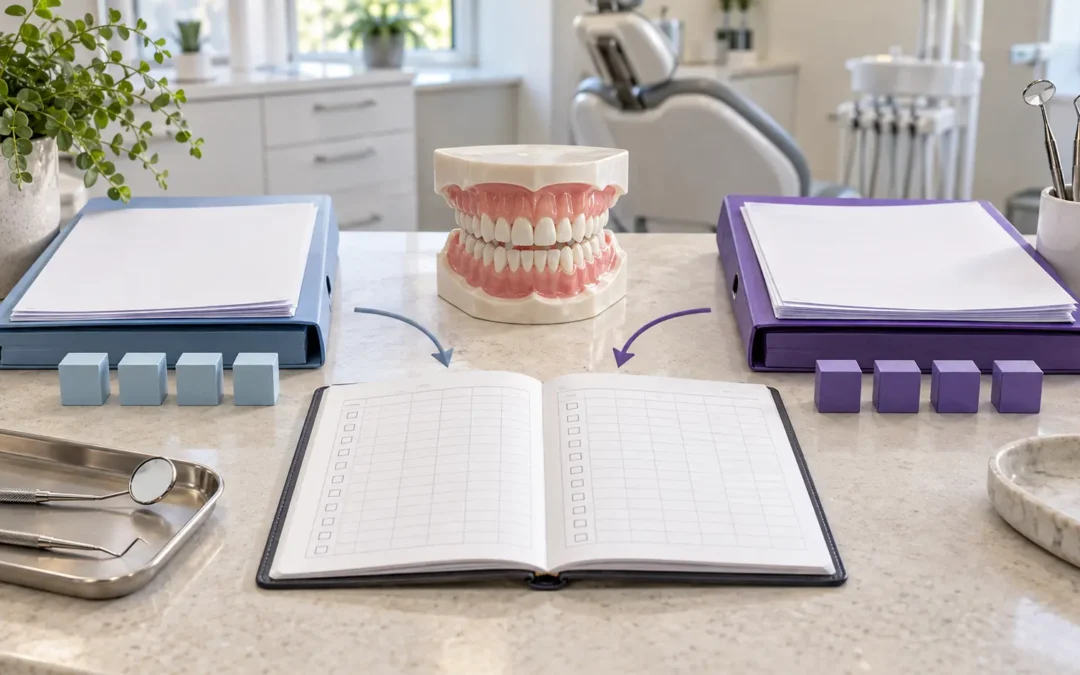
Most UK dental practices operate with a combination of NHS and private income. Although both may arrive in the same business bank account, they should not be grouped into one general sales figure.
NHS contract payments, private treatment fees, patient-finance receipts and membership-plan income can follow different payment patterns and accounting treatments. Combining everything makes it harder to understand profitability, monitor contract performance, assess VAT exposure and prepare accurate year-end accounts.
A suitable accounting structure should therefore:
- Record NHS and private income separately
- Divide private revenue into meaningful categories
- Reconcile NHS payments against contract activity
- Distinguish completed treatment from advance payments
- Track membership-plan obligations
- Separate exempt and potentially taxable income
- Produce monthly management reports that practice owners can use
This guide explains how to structure NHS vs private dental income and why doing so gives practice owners clearer, more useful financial information.
The Short Answer: Should NHS and Private Income Be Separated?
Yes. NHS and private income should be recorded in separate bookkeeping categories, even when both are received into the same bank account.
You do not necessarily need separate bank accounts. However, your accounting software should make it possible to report NHS contract income, private treatment fees, plan income, patient-finance receipts and taxable retail sales independently.
A useful starting structure might include:
| Income category | What it should include |
|---|---|
| NHS contract income | Regular NHS contract payments and confirmed adjustments |
| NHS contract adjustments | Clawback, carry-forward or agreed contract corrections |
| Private treatment income | Fees for completed private dental treatment |
| Membership-plan income | Monthly capitation or dental-plan receipts |
| Patient-finance income | Amounts received through treatment-finance providers |
| Cosmetic services | Services requiring separate VAT assessment |
| Retail sales | Toothbrushes, kits and other separately sold products |
| Other professional income | Consultancy, reports or non-clinical services |
The exact nominal codes will depend on your software and practice structure, but the principle is consistent: each materially different income stream should be identifiable.
Why NHS and Private Income Need Separate Treatment
NHS and private income differ in three important areas:
- How the cash is received
- When revenue should be recognised
- How VAT may apply
NHS income follows the contract
NHS practices normally receive regular contract payments. The amount received during a particular month may not directly match the activity delivered in that same month.
Consequently, looking only at the bank balance does not show whether the practice is meeting its contractual activity target.
Private income follows patient activity and payment arrangements
Private income may be collected:
- When treatment is booked
- As an advance deposit
- At individual treatment stages
- When treatment is completed
- Through an external finance provider
- Through a monthly membership plan
The date on which cash is received is not always the same as the date on which it should be recognised as revenue.
Different supplies may have different VAT treatments
Qualifying dental care and treatment can be VAT-exempt whether supplied privately or through the NHS. However, purely cosmetic services, retail products and certain consultancy activities may be taxable.
A single undivided “dental income” category makes it difficult to monitor taxable turnover or support a partial-exemption calculation.
How to Structure NHS Income
NHS contract income should be recorded against the relevant payment schedules and reconciled with contract performance throughout the year.
Depending on the practice and UK nation, the supporting records may come from NHSBSA, NHS England, the relevant ICB or another commissioning body.
Record regular payments consistently
Each NHS payment should be:
- Recorded in a dedicated NHS income account
- Matched to the supporting payment schedule
- Reconciled against the amount received in the bank
- Reviewed for adjustments, deductions or prior-period corrections
- Assigned to the correct accounting period
If a payment differs from the expected amount, investigate it when the transaction occurs rather than leaving the difference unresolved until year-end.
Monitor UDA performance separately
The accounting system records the financial value, but operational records are needed to monitor Units of Dental Activity and other contractual measures.
Your monthly review should compare:
- Annual contract value
- Contracted UDA target
- UDAs delivered to date
- Expected delivery based on the time elapsed
- Forecast year-end delivery
- Potential carry-forward
- Estimated exposure to clawback
This is important because regular contract payments can create the appearance of stable financial performance even when activity is below target.
Account for underperformance and clawback carefully
NHSBSA confirms that contracts undergo a year-end reconciliation comparing contracted targets with actual activity. The consequences depend on performance levels and the applicable contract terms.
If underperformance is likely to create a repayment obligation, your accountant may need to consider whether NHS income should be reduced and whether a corresponding liability should be recognised.
Do not wait for money to be physically recovered before informing your accountant. Provide:
- Current activity reports
- The estimated underperformance
- Relevant NHS correspondence
- Any confirmed recovery notice
- Evidence supporting an agreed carry-forward
- Details of contract variations or exceptional arrangements
The accounting entry must reflect the circumstances and information available at the reporting date. Current reconciliation information is available through the NHS Business Services Authority.
Record contract variations separately
If the contract value changes during the year, keep the formal documentation supporting that change.
A variation may result from:
- An agreed change in activity
- A transfer or reduction in contract value
- A new service
- A temporary arrangement
- A commissioning adjustment
- A change affecting the delivery period
Without the supporting documentation, an accountant may interpret a changed payment as a bookkeeping discrepancy instead of a genuine contract amendment.
Worth knowing: A practice can receive predictable monthly cash while developing a significant UDA shortfall. Contract performance must therefore be reviewed alongside financial performance.
How to Structure Private Income
Private income is usually more fragmented than NHS income. It should be separated according to the way the service is provided and paid for.
At a minimum, consider distinct categories for:
- Fee-for-service treatments
- Treatment deposits
- Staged treatment payments
- Membership or capitation plans
- Patient-finance receipts
- Cosmetic services
- Retail products
- Refunds and write-offs
One combined “private sales” account may be adequate for recording total cash, but it will not provide the detail needed for useful management reporting or a reliable VAT review.
Private Fee-for-Service Treatment
Private treatment income should be linked to the service provided rather than recorded solely according to the date cash reaches the bank.
For straightforward treatment completed in one appointment, this may be relatively simple. More complex treatment plans can involve:
- Advance deposits
- Several clinical stages
- Lab work
- Interim payments
- Completion balances
- Refunds or treatment-plan changes
Your dental practice bookkeeping should provide a consistent way to distinguish:
- Completed treatment
- Work still in progress
- Advance patient payments
- Unpaid patient balances
- Cancelled treatment
- Refundable amounts
The correct treatment depends on the contractual arrangement and the accounting framework applied. Cash received before the practice has fulfilled the relevant service obligation may need to remain on the balance sheet rather than being treated immediately as revenue.
Patient-Finance Arrangements
When a patient uses an external finance provider, the gross treatment price and the net amount received may differ because the provider deducts a fee.
The records should show:
- The full value charged for treatment
- The finance-provider fee
- The amount deposited into the bank
- The patient and treatment reference
- The date the practice became entitled to the income
- Any subsequent refund or cancellation
Recording only the net bank receipt as sales can understate both revenue and finance-related costs.
A clearer approach is normally to record the appropriate gross treatment income and show the provider’s fee separately, subject to your accountant’s advice and the terms of the arrangement.
Reconciling Private Income Properly
Each month, private income should be reconciled across three sources:
- Practice-management software
- Payment-provider and bank records
- Accounting software
The reconciliation should cover:
- Card-terminal receipts
- Online payment links
- Cash receipts
- Bank transfers
- Finance-provider receipts
- Membership-plan transfers
- Patient deposits
- Refunds
- Chargebacks
- Written-off balances
Where the totals do not agree, investigate whether the difference relates to timing, processing fees, deposits, refunds, unbanked cash or an incorrectly recorded transaction.
Regular reconciliation is particularly important where several clinicians, locations or payment systems are involved.
Related reading: Bookkeeping for Dentists: The Complete Guide
Membership and Plan Income: Avoiding the Deferred-Income Trap
Dental plan income accounting requires more care than simply treating every monthly receipt as immediate revenue.
A membership plan may include several promises, such as:
- Access to the practice
- Regular examinations
- Hygiene appointments
- Emergency support
- Discounts on treatment
- Ongoing monitoring or preventive care
The correct revenue pattern depends on what the practice has promised and when those services are provided.
Some obligations may be fulfilled evenly over the membership period. Others may relate to identifiable appointments or future treatment. This means plan income should not automatically be recognised entirely on receipt, but neither should it automatically remain deferred until a particular appointment takes place.
For accounting periods beginning on or after 1 January 2026, the revised revenue model in FRS 102 focuses on recognising revenue when or as contractual performance obligations are satisfied. Advance payments for services not yet transferred are generally shown as contract liabilities. The exact treatment will depend on the reporting framework and the terms of the dental plan. See the Financial Reporting Council’s current FRS 102 guidance.
Information your accountant may need
Provide:
- The membership agreement
- Details of services included
- Monthly plan fees
- Patient numbers
- The timing and frequency of included services
- Plan-provider deductions
- Refund and cancellation terms
- Opening and closing deferred-income calculations
- Any changes to plan prices or benefits
Why this matters
Recognising too much revenue too soon can overstate profit and understate liabilities. Deferring too much can understate current performance.
A documented and consistently applied method gives practice owners more reliable monthly reports and creates a clearer year-end audit trail.
Important: The appropriate recognition method should reflect the actual plan contract. It should not be based on an arbitrary percentage or used simply to smooth profits.
VAT Implications of a Mixed-Income Dental Practice
Dental practice VAT is determined by the nature and purpose of the supply—not simply whether the patient pays privately or through the NHS.
HMRC states that dental care and treatment supplied by an appropriately registered professional can be exempt when its primary purpose is protecting, maintaining or restoring health.
However, other supplies may be taxable.
VAT-exempt dental supplies may include
Subject to the relevant conditions:
- NHS dental treatment
- Private treatment with a qualifying healthcare purpose
- Dental prostheses
- Drugs or appliances supplied as part of qualifying dental treatment
- Certain medically necessary cosmetic procedures
Potentially taxable supplies may include
Depending on the facts:
- Services performed purely for cosmetic reasons
- Separately sold toothbrushes
- Toothpaste and dental floss
- Home-whitening products sold separately
- Consultancy or advisory services
- Sales of dental equipment
- Other non-clinical services
HMRC’s dental guidance explains that cosmetic dentistry must be assessed case by case. It is exempt only when supplied as part of an oral-health treatment programme by an appropriately registered professional. See VAT Notice 701/57.
Does all practice turnover count towards VAT registration?
No. The compulsory VAT-registration test is based on taxable turnover rather than exempt dental income.
The current VAT-registration threshold is £90,000 of taxable turnover over the relevant period. A large practice with mostly exempt clinical income may therefore have a different VAT position from a smaller practice generating substantial taxable cosmetic, retail or consultancy income.
The threshold and registration tests are explained in the official GOV.UK VAT registration guidance.
Partial exemption
A VAT-registered practice making both exempt and taxable supplies may not be able to recover all the VAT incurred on shared overheads.
Costs could fall into three categories:
- Directly related to taxable supplies
- Directly related to exempt supplies
- Shared between taxable and exempt activity
Shared or residual input VAT may require apportionment. HMRC’s Partial Exemption Notice 706 explains the calculation principles and annual adjustment requirements.
Separating income categories throughout the year makes this calculation more reliable and easier to support.
Recommended Monthly Bookkeeping Process
A structured monthly process can prevent most year-end problems.
1. Reconcile all payment accounts
Reconcile:
- Business bank accounts
- Credit cards
- Card terminals
- Online payment platforms
- Finance-provider statements
- Membership-plan provider statements
2. Reconcile NHS income
Match the NHS receipt against the payment schedule and review any unexpected adjustments.
3. Update activity performance
Compare UDA or other contract delivery against the year-to-date target and revise the year-end forecast.
4. Reconcile private treatment income
Compare the practice-management report against amounts received, outstanding patient balances and advance payments.
5. Review plan income
Update patient numbers, fees, cancellations and the calculation for any contract liability or deferred element.
6. Check VAT-sensitive income
Review cosmetic services, retail sales and consultancy income instead of waiting until the VAT threshold is approached.
7. Review exceptions
Investigate:
- Unallocated receipts
- Old patient balances
- Unidentified bank transactions
- Unusual refunds
- Negative income entries
- Suspense-account balances
- Differences between clinical and accounting reports
8. Produce a management report
The final monthly report should show NHS and private performance separately.
Management Information a Mixed Practice Should Review
Accurate mixed income dental accounts should help the owner manage the practice—not merely satisfy year-end compliance.
Useful monthly measures include:
- NHS income received
- NHS contract value and delivery percentage
- Forecast clawback or carry-forward
- Private treatment income
- Membership-plan income
- Patient-finance income
- Taxable retail and cosmetic income
- Revenue by clinician
- Revenue by treatment category
- Lab costs
- Associate payments
- Staff costs
- Deferred or advance income
- Outstanding patient balances
- Gross profit and operating profit
- Cash available after liabilities
NHS performance
Review whether activity is:
- On target
- Ahead of target
- Behind target
- Recoverable before year-end
- Likely to produce carry-forward or clawback
Private performance
Review:
- Private revenue growth
- Average patient value
- Treatment acceptance
- Membership-plan growth
- Finance-provider costs
- Refund levels
- Income by clinician or service
This allows owners to identify whether private growth is genuine, whether margins are improving and whether NHS underperformance is being hidden by rising private revenue.
Common Bookkeeping Mistakes in Mixed Dental Practices
Avoid these common problems:
- Recording every receipt as general sales
- Relying only on the bank balance
- Recording finance-provider receipts at the net amount without showing fees
- Recognising every patient deposit immediately as revenue
- Treating every plan receipt in the same way regardless of the contract
- Ignoring likely NHS clawback until payment is recovered
- Failing to document contract variations
- Combining clinical services and retail sales
- Monitoring the VAT threshold using total turnover instead of taxable turnover
- Completing reconciliations only at year-end
- Leaving payment differences in a suspense account
- Failing to reconcile clinical software with accounting software
These errors may distort profitability, delay year-end work and make the practice’s management reports less useful.
What Your Accountant Will Need at Year-End
Prepare:
- NHS contract documentation
- Annual contract value
- UDA or other activity reports
- Monthly NHS payment schedules
- Contract-variation documents
- Clawback and carry-forward correspondence
- Full private-income reports
- Patient deposit records
- Membership-plan agreements
- Plan-provider statements
- Patient-finance statements
- Merchant-service reports
- Refund and chargeback records
- Details of unpaid patient balances
- VAT returns and calculations where applicable
- Deferred-income or contract-liability calculations
- Explanations for unusual transactions
For the complete wider year-end records list, read Dental Practice Accounts: End-of-Year Checklist.
Why This Structure Helps You Run the Practice
Separating NHS and private income produces clearer answers to important management questions:
- Is the practice meeting its NHS obligations?
- Is private income genuinely increasing?
- Which treatments generate the strongest contribution?
- Are finance and plan-provider charges affecting margins?
- Is patient money being received before services are provided?
- Is taxable turnover approaching the VAT threshold?
- Which clinicians or services are driving growth?
- Is a possible clawback already reflected in financial forecasts?
Practices that monitor only total turnover may discover problems after several months. Practices that review NHS, private, plan and taxable income independently can identify the same issues earlier and respond while there is still time.
Need Help Structuring Your Dental Practice Accounts?
Samsaad supports dental practices and associates with mixed NHS and private income, dental practice bookkeeping, year-end accounts, payroll, tax planning and management reporting.
Working with an experienced accountant for dental practices can help you:
- Establish suitable bookkeeping categories
- Reconcile NHS and private income
- Review UDA performance
- Account for membership plans
- Monitor dental practice VAT
- Produce clearer monthly management information
- Prepare more efficiently for year-end
Book a free 30-minute consultation with Samsaad to discuss your dental practice and the accounting support you need.
Dental associates can also read Tax Planning for Dental Associates: 7 Legal Ways to Reduce Your Bill.
Frequently Asked Questions
Answers to common questions about structuring NHS and private income within a UK dental practice.
Do I need separate bank accounts for NHS and private income?
Separate bank accounts are not normally a legal requirement. Many practices receive NHS and private payments into the same account. However, every transaction should be assigned to the correct bookkeeping category so each income stream can be reconciled and reported separately.
How should membership plan income be recognised?
The treatment depends on what the membership agreement promises and when those services are provided. Revenue may be recognised over the membership period or when specific obligations are fulfilled. Amounts received before the relevant services are transferred may need to remain as a contract liability or deferred income.
Does my dental practice need to be VAT registered?
A practice making only VAT-exempt qualifying dental supplies will not normally register solely because of that exempt income. Registration may become compulsory when taxable turnover from cosmetic, retail, consultancy or other taxable activities exceeds the applicable threshold. Review the nature of each supply rather than relying on total practice turnover.
What should I do if I have underperformed my UDA target?
Calculate the likely shortfall, review the applicable reconciliation rules and give your accountant the latest activity reports and NHS correspondence. If a clawback is probable and relates to the reporting period, your accountant can assess the appropriate income adjustment and liability even if the final amount has not yet been confirmed.
How often should NHS and private income be reconciled?
Monthly reconciliation is usually the most useful approach. It helps identify missing transactions, payment differences, UDA underperformance, unallocated deposits and VAT-sensitive income while there is still time to correct the records or respond operationally.